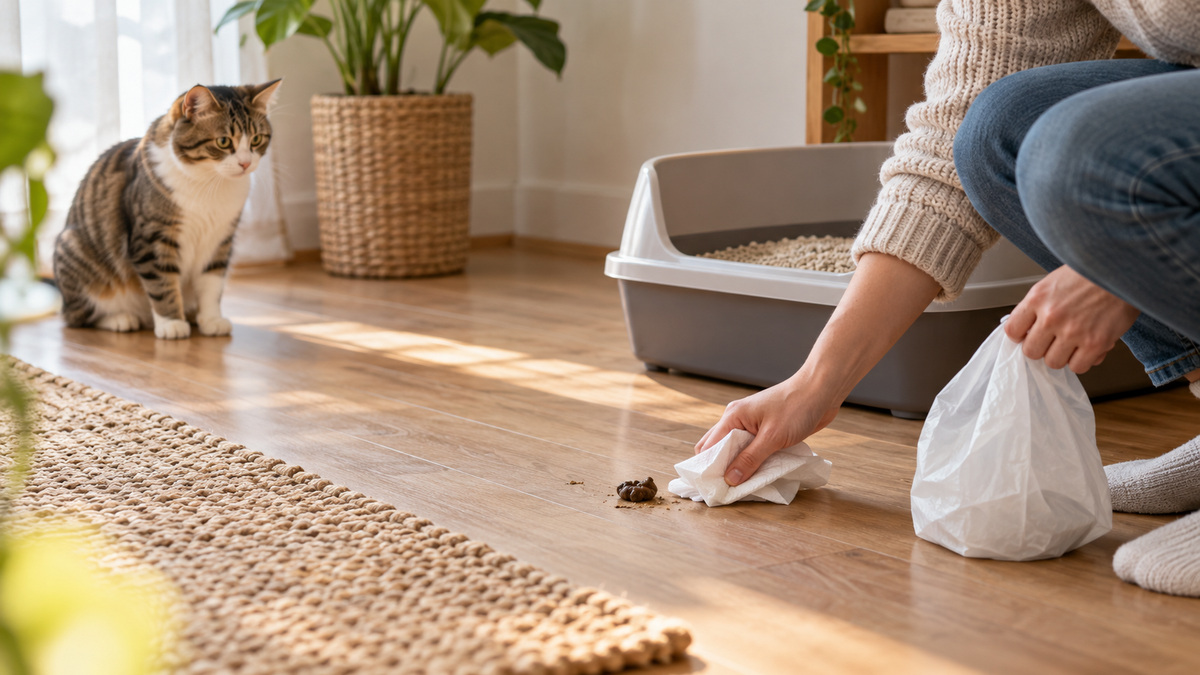
Why Is My Cat Pooping Outside the Litter Box? Causes and Fixes
As an Amazon Associate we earn from qualifying purchases. Details
When a cat is pooping outside litter box, the first step is a vet check, not a new box. Cornell’s Feline Health Center says a cat may have litter box trouble for several reasons: a medical problem, an aversion to the box, or a preference for going somewhere else. The ASPCA lists related causes, including too few boxes, a box that is too small or hard to reach, a box that is dirty, and stress. This guide takes those causes in order: health first, then the box count, the box itself, cleaning, location, stress and the needs of older cats.
Quick answer
- Book a vet visit first. The ASPCA says the first step is to rule out medical problems and urine marking, and it recommends a thorough veterinary check. Cornell notes that many medical conditions can disrupt normal urination and defecation.
- Count the boxes. Cornell’s rule is cats plus one, so a home with two cats needs three boxes.
- Match the box to the cat. Cornell says larger cats need bigger boxes, and that kittens, elderly cats and cats with mobility problems need low sides.
- Check cleaning, location and stress. Scoop at least once a day, keep the box in a quiet spot that is easy to reach, and note any stressful change at home.
Start with the medical checks
A cat that starts pooping outside the box should see a veterinarian before the litter or the box is changed. The ASPCA’s first step is direct: “Have your cat checked thoroughly by a veterinarian.” Cornell lists medical problems first among the reasons a cat may stop using its box, and it notes that any condition affecting normal urination or defecation can cause box problems.
Cornell describes how digestive tract problems can affect the box. They may make defecating painful, raise how often or how urgently a cat needs to go, and reduce the cat’s control over defecation. Age-related diseases that limit mobility or cognition can also affect whether a cat reaches the box in time. Cornell also names kidney and thyroid disease and diabetes, which often lead a cat to drink more and urinate more often.
Pain can outlast its cause. The ASPCA explains that a cat whose medical condition hurt when it eliminated may come to link the discomfort with its litter box. That link can continue after the health problem has resolved, so the cat may keep avoiding the box even when it is well again. The ASPCA describes ways to build new, pleasant associations with the box, but those steps come after the health check.
This guide does not say what disease a cat has or how to treat one, and the sources we opened do not either. Cornell notes that consulting a veterinary behaviorist may give important insight into the cause of inappropriate elimination. If your cat strains or seems to be in pain when it goes, tell your vet promptly.
The box count rule
Cornell’s rule is short: “Keep as many litter boxes as cats in the house – plus one.” The ASPCA gives the same count in different words, asking for a box for each cat plus one extra. Its example is three cats and a minimum of four boxes. Both sources agree, so the rule is the clearest number in this guide.
The rule is a simple calculation. Boxes needed = cats in the home + 1. The table below applies that formula to one to four cats.
| Cats in the home | Calculation (cats + 1) | Boxes to have |
|---|---|---|
| 1 | 1 + 1 | 2 |
| 2 | 2 + 1 | 3 |
| 3 | 3 + 1 | 4 |
| 4 | 4 + 1 | 5 |
For a home with five cats, the same formula gives 5 + 1 = 6 boxes. The rule counts cats in the home, and the sources do not say how to count a cat that only visits. A single cat that is pooping outside the box therefore needs two boxes under this rule, not one.
Where the boxes sit matters as much as how many there are. Cornell says to place multiple boxes in different areas of the house, and the ASPCA notes that a multistory home may need a box on each level.
Box size, sides and liners
Cornell says overweight and large cats need bigger boxes, and that young kittens, elderly cats and cats with mobility problems need boxes with low sides. The ASPCA adds that most cats prefer large boxes they can enter easily, and it warns that geriatric cats or cats with physical limitations may have trouble with top-entry boxes or boxes with high sides. A box that is too small, or hard to get into, is a practical reason a cat may go somewhere else.
Both sources use general terms such as bigger and low. Neither gives a box length in inches or a side height in inches, so this guide gives no such number. When you compare boxes, read the length, width and side height on the listing, and compare them with your cat’s size and any mobility limits your vet has discussed with you.
Covers are a separate question. Cornell notes that most cats prefer an uncovered box that lets odors escape and allows a 360-degree view. It also says that a covered box can hold odors in from the cat’s point of view, so you may need several types of box and litter before you find the combination the cat likes best. Replace old boxes that smell or are cracked.
Liners are similar. The ASPCA lists a hood or liner that makes the cat uncomfortable as a cause of elimination outside the box, and it advises removing covers and liners from all boxes. Cornell says a liner may help keep the box cleaner, but many cats do not like them. If the problem began after a hood or liner was added, removing it is the change the ASPCA recommends.
Cleaning the box often enough
Cornell’s routine for clumping litter is to remove feces and clumps daily and add clean litter as needed. The ASPCA sets a similar standard: virtually all cats like clean boxes, so the litter should be scooped and changed at least once a day. Cornell adds that the more cats use a box, the more often it needs cleaning. Its standard for the litter itself is that it should look and smell dry and clean.
In a home with several cats, a shared box needs more frequent attention than a box in a single-cat home. Judge the litter by Cornell’s standard: does it look and smell dry and clean? If not, it is due for a change, whatever the schedule says.
The ASPCA’s weekly routine is to clean all boxes with warm water and unscented soap, baking soda or no soap, and to replace all the litter. It warns that scented cleaners are a problem because a cat could develop an aversion to the scent. Both sources favor unscented products, and the ASPCA adds that cats generally prefer clumping litter with a medium to fine texture.
Depth matters too. The ASPCA says: “Provide one to two inches of litter rather than three to four inches.” Keep the layer in that range and add clean litter as needed, as Cornell advises.
A cat may also have a settled preference for a litter. The ASPCA notes that cats usually develop a preference for litter type and scent as kittens, and that some cats adjust to a change of litter while others do not. If you change litter, Cornell advises doing it gradually.
Location, privacy and access
Cornell says most cats prefer a location that is quiet, private, separate from their food, and easily reachable at all hours. The ASPCA adds that cats like a box that is not tucked into a corner. They like to see people or animals approaching, and they like more than one escape route. The ASPCA advises keeping boxes out of busy, loud or intimidating places and away from areas where a cat might feel trapped. Its examples include a spot next to a washer and dryer or next to the dog’s food and water bowls.
Food and litter should also be kept apart. The ASPCA suggests putting food bowls somewhere other than right next to the box, and Cornell notes that cats usually do not like to eliminate close to their food.
Think about the route to the box and about other animals. Cornell asks whether another animal frightens the cat while it is in the box or as it leaves. If that happens, Cornell suggests a box with a 360-degree view, with more than one way out rather than a box surrounded on three sides, and several boxes in several locations so the cat has more options.
Older cats and cats with mobility problems
Cornell’s guide to older cats says that as cats age they become more prone to arthritis and may have reduced control over their bowels and bladder. Its answer is to put a litter box on every floor so the boxes are easy to reach. Cornell also advises against placing a box upstairs or downstairs when a cat has trouble climbing stairs. It says older cats should have easy access to food, water and litter boxes, so they do not have to climb stairs if they choose not to, and that food and water bowls may need to be in more than one place.
The same page describes a pattern that matters for this question. Some older cats climb into a normal litter box to urinate but not to defecate. In other words, the cat may use the box for urine and not for feces. Cornell’s suggestion for this is a box with very low sides, such as a large cookie sheet, or newspaper placed around the box. Cornell also warns against blaming age for changes in behavior or health, because such changes can be signs of common diseases. Any change in behavior or health warrants a visit to the veterinarian without delay, so ask your vet to check for a health reason.
For a cat that has trouble with steps, Cornell gives a practical idea: “The idea is to provide firm footing; for example, cover steps or a ramp with carpet to prevent slipping.” This is about a safe route to the box or to a favorite spot. Use steps or a ramp only if your vet agrees the cat can use them safely.
The low-sided box is the common thread for older cats. The ASPCA suggests switching to a box with low sides when a cat is older, arthritic or very young and has trouble with high sides or a top-side opening. Cornell says elderly cats need low sides. Neither source gives a height in inches, so look at the entry height on the listing and watch how the cat steps in and out.
Stress, other cats and changes at home
The ASPCA says stress can cause litter box problems. It notes that cats can be stressed by events owners may not think of as traumatic, such as moving, adding new animals or family members, or even a change in the daily routine. Cornell adds that older cats cherish predictable days more than younger cats do, and that keeping to normal routines reassures them.
If a change came just before the cat began pooping outside the box, note the date and what changed. The ASPCA suggests identifying stress sources and removing them where possible. That can mean keeping food bowls full and in the same place, keeping the routine predictable, stopping a dog from chasing the cat, and closing blinds so the cat is not upset by cats outside. The ASPCA also mentions synthetic pheromone sprays or diffusers, which it says have shown some effect in relieving stress in cats. Ask your vet before giving any medication for a behavior problem.
Where more than one cat lives in the home, watch the boxes. The ASPCA says that one or more cats can control access to the boxes and keep the others from using them, and that even a cat that is not confronting another can create enough stress to cause box problems. Adding a box in a different area follows Cornell’s advice to place boxes in different areas. If there is conflict and one cat seems stressed, the ASPCA suggests extra boxes where that cat spends most of its time, plus resting places for each cat, such as vertical spots on shelves or cat trees. It also suggests spreading food, water, posts and boxes around so the cats do not have to meet at the same resources.
If you have several cats and do not know which one is soiling, the ASPCA says to speak with your veterinarian about giving one cat a harmless dye, fluorescein, which makes urine glow blue under ultraviolet light for about 24 hours. If that is not possible, the ASPCA suggests confining the cats one at a time.
A step-by-step check
Work through the following steps in order. Stop at any step that points to a medical problem and call your vet.
- Ask your vet to check the cat. The ASPCA puts a rule-out of urine marking and medical problems first, with a thorough veterinary check.
- Count the cats in the home and compare that number with the boxes you have. Use cats + 1.
- Check the box size and the sides. Larger cats need bigger boxes, and kittens, elderly cats and cats with mobility problems need low sides.
- Look at the cleaning routine. Scoop at least once a day, replace all the litter with a weekly full clean, and keep the layer at one to two inches.
- Check the location. The box should be quiet, easy to reach at any time, separate from the food and away from busy spots.
- Think about stress and change. Note any new animal, move or change in routine that came before the problem.
- Clean the spot where the cat went. The ASPCA suggests cleaning accidents thoroughly with an enzymatic cleanser, placing a box where the cat has soiled a few spots, and making other surfaces less pleasant to stand on, such as with upside-down carpet runners or double-sided tape.
The ASPCA warns that once a cat avoids its box, the avoidance can become a chronic problem, because the cat can develop a surface or location preference, such as a living room rug or a favorite chair. Its advice is to act quickly. If you do not see a change after the count, size and cleaning steps, go back to your vet and tell them what you have changed.
How we chose
This guide answers one question: why a cat poops outside the litter box, and what a cat owner can check first. We picked two pages from Cornell’s Feline Health Center, a veterinary school resource, and one ASPCA page on litter box problems, which is written for owners. We opened each page, saved its text, and matched every quotation against that text. A quote that did not match the saved page was dropped.
We did not rank products, and this guide does not name any product. The aim was to explain the causes and the checks in an order a cat owner can follow. Where a point depends on a product, the guide says what to look for on the listing, such as the box length and side height, rather than recommending a brand.
What we could not verify
The sources we opened do not give a box length in inches or a side height in inches, so this guide gives no size numbers beyond the count rule.
The sources we opened do not say how long a cat takes to return to a box after a problem, so no timeline is given.
The sources we opened name baking soda, unscented soap and enzymatic cleansers, but they do not say which cleaning products are safe for every type of box or surface.
The ASPCA lists urine marking as a separate problem to rule out, but the sources we opened do not give a step-by-step way to tell urine marking from other elimination outside the box. Ask your vet if you are not sure which is happening.
The sources we opened do not cover the cause of any single cat’s problem. The causes listed here are the ones the sources name, and the right one for your cat is a question for your vet.
FAQ
Should I see a vet if my cat only poops outside the box?
Yes. The ASPCA recommends a thorough veterinary check before other changes, and Cornell notes that medical conditions affecting urination or defecation can cause box problems. Digestive problems can make defecating painful, so a vet can check for pain or digestive trouble. Do this first, before you change the litter or the box.
How many litter boxes do I need for two cats?
Three. Cornell’s rule of cats plus one gives 2 + 1 = 3 boxes, and Cornell advises placing them in different areas of the house.
Can an older cat pee in the box but poop outside it?
Cornell says that can happen: some older cats climb into a normal box to urinate but not to defecate. Cornell suggests a box with very low sides, such as a large cookie sheet, or newspaper around the box. Ask your vet about the cause, since mobility and digestive problems can both be involved.
Does the type of litter matter?
It can. The ASPCA says most cats prefer clumping, unscented litter, and that a cat may prefer the type it used as a kitten. Cornell’s advice on daily removal of clumps is written for clumping litter, and Cornell advises switching brands gradually, adding small amounts of the new litter to the old. Keep the layer shallow, at one to two inches, as the ASPCA advises.
Can stress cause a cat to poop outside the box?
Yes. The ASPCA says stress can cause litter box problems, and that events such as moving, new animals or a change in routine can make a cat anxious. Conflict between cats can also be a source. Note what changed and when, and tell your vet, because the cause still needs a medical check.
Should I clean the spot where the cat went?
Yes. The ASPCA advises cleaning accidents thoroughly with an enzymatic cleanser designed to neutralize pet odors. It warns that an ammonia-based cleaner could attract the cat back to the same spot, and Cornell advises avoiding cleaners that contain ammonia or vinegar because they smell like urine. The sources do not name a product, so check the label of any cleaner you choose.
Bottom line
Use one rule: if your cat is pooping outside the box, get a vet check first, then keep one more box than you have cats, place the boxes in different areas, and use low sides for older or less mobile cats. If the count is right and the vet finds no medical cause, work through box size, cleaning, location and stress one point at a time, and write down each change you make.
Sources
- Cornell Feline Health Center, Feline Behavior Problems: House Soiling: box count rule (cats plus one), larger boxes for large and overweight cats, low sides for kittens and elderly cats, daily removal of clumps, quiet and accessible location, medical causes and digestive pain, and veterinary behaviorist referral.
- ASPCA, Litter Box Problems: vet check first, a box per cat plus one, daily scooping, weekly rinse with baking soda or unscented soap, unscented clumping litter, litter depth, liners and lids, high sides and top entry for geriatric cats, stress, and pain-linked avoidance.
- Cornell Feline Health Center, Loving Care for Older Cats: boxes on every floor, older cats that urinate but do not defecate in a box, and firm footing for steps or ramps.